Laser Hair Removal
November 10, 2026
1
min. to read
PCOS (PMOS) Medication and Laser Hair Removal: What Actually Works Together
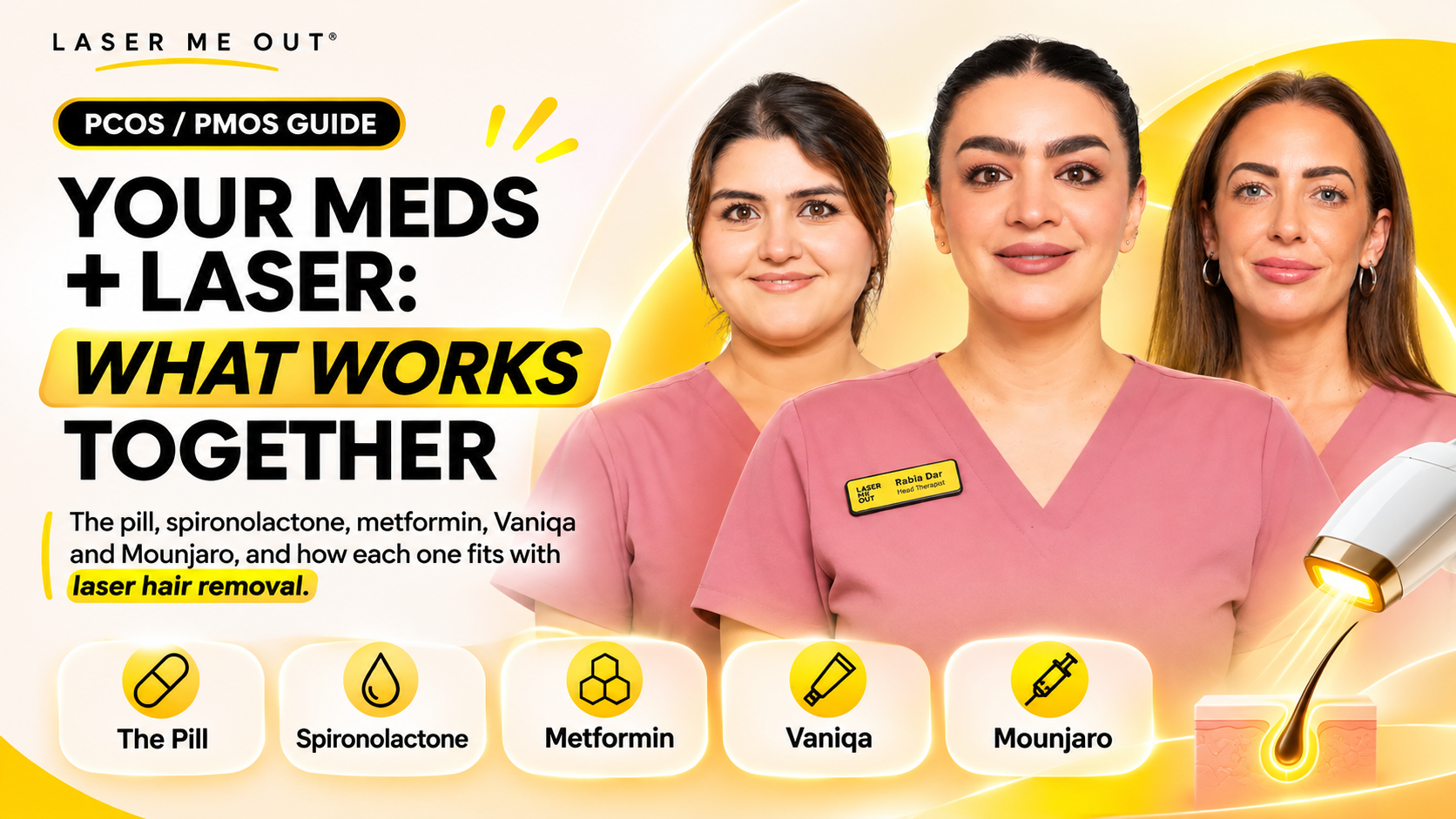
Your GP has just started you on spironolactone. Or metformin. Or, after years of asking, you've finally been offered Mounjaro. Then the questions start. Do I still need laser? Should I wait until the tablets kick in? Will my medication mess with my sessions?
Good news first: you don't have to choose. Medication and laser hair removal do different jobs, and for most people with PMOS they work best together.
Since PCOS was officially renamed polyendocrine metabolic ovarian syndrome (PMOS) in May 2026, more people are being treated for the hormone and metabolic side of the condition, not just their periods. That's a big step forward. It also means more of you are booking laser while starting, switching or stopping medication. This guide walks you through each one.
The quick answer
- Medication and laser tackle hair from opposite ends. Medication turns down the hormones that switch follicles on. Laser deals with the follicles already growing hair.
- The most common PMOS medications don't stop you having laser. You just need to tell us what you take, and tell us again whenever it changes.
- Don't wait months to start. Your laser course can run alongside your medication from day one.
- A few medicines do matter. Anything that makes your skin more sensitive to light needs flagging before a session.
Black Friday PMOS offer: 12 sessions of Top to Tail laser, face included, for £1,999.99. Ends 30 November. Book your consultation or read the details below.
One promise from us: we're a laser hair removal clinic, not your doctor. We'll never ask you to start, stop or change a medication for your laser plan. That conversation belongs with your GP or specialist.
Still waiting on a diagnosis? Start with our 5 signs you might have PCOS. Want to know why this matters so much to us? Our founder shares her own PCOS hair story.
Why medication and laser work better together
PMOS hair is driven by androgens, the so-called "male" hormones such as testosterone. Extra insulin nudges your ovaries to make more of them. Those androgens then turn soft, fine hairs into thick, dark ones on your chin, jawline, neck, chest and tummy.
Laser and medication tackle that from opposite ends:
- Laser targets the hair you can see right now. The light heats the follicle and stops it growing back as strongly.
- Medication turns down the hormone signal, so fewer new follicles get switched on in the first place.
That's why laser on its own can feel like whack-a-mole with PMOS. You clear an area, then your hormones wake up new follicles nearby. Medication slows that down, and laser clears what's already there. Together, results tend to hold for longer between maintenance sessions.
It's also why we ask about medication at every single visit. When your hormones shift, your hair shifts too, and we'd rather adjust your plan before you notice regrowth than after.
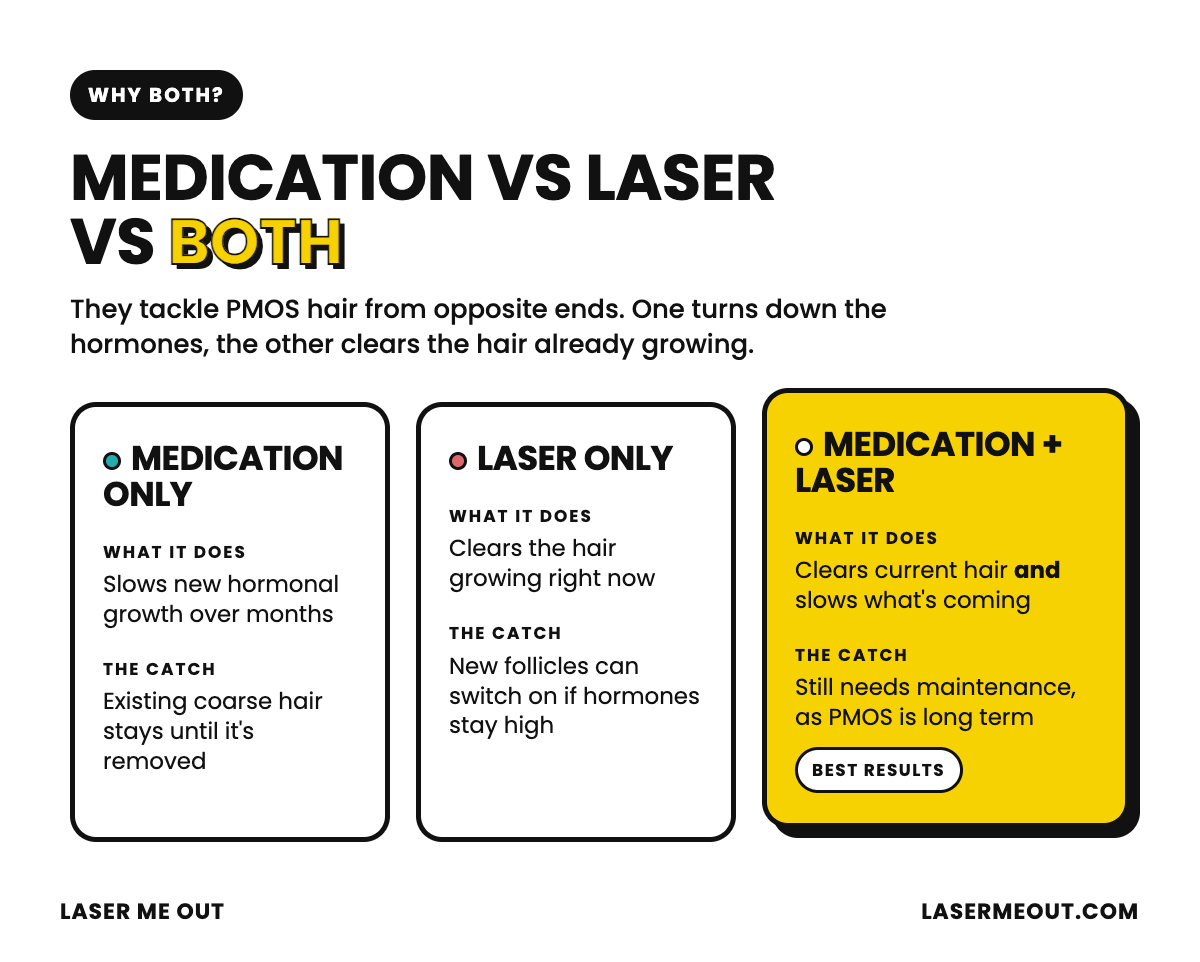
If you've ever wondered why your PCOS hair keeps coming back, this is the reason. Hormones keep the supply line open, so the best plans deal with both ends. It's exactly how we build our PCOS laser hair removal plans.
What the research actually says
This isn't just us saying it. Here's what the evidence shows about laser and medication for PMOS hair:
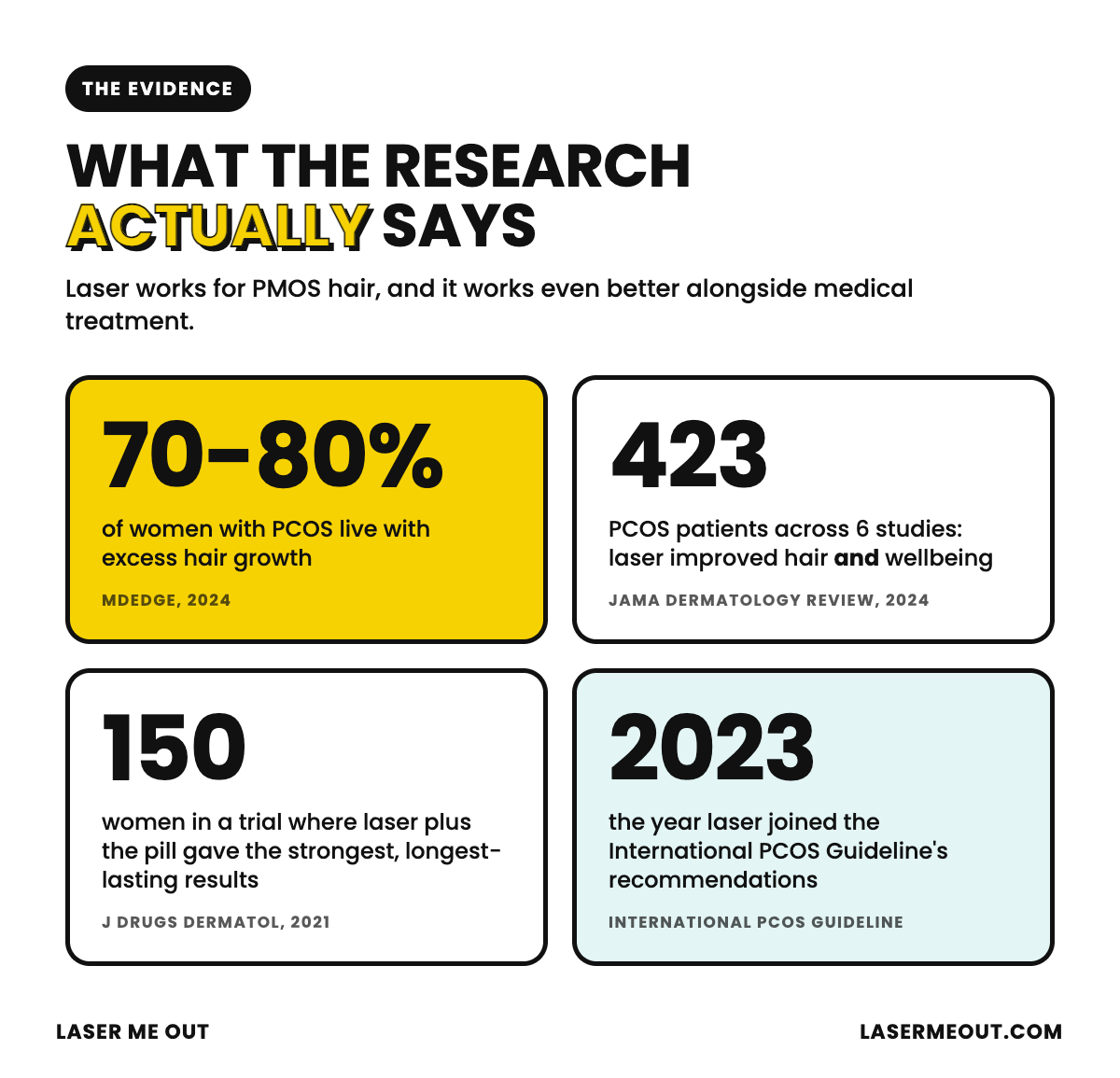
- Hair growth is one of the most common PMOS symptoms. Excess hair affects an estimated 70 to 80% of women with PCOS, and it's linked to lower self-esteem and quality of life.
- Laser works for PMOS hair. A 2024 systematic review in JAMA Dermatology looked at 6 studies and 423 patients with PCOS. Laser improved both hair growth and psychological wellbeing.
- Laser plus medication beats laser alone. The same review found diode laser combined with metformin or the pill gave better results than laser on its own.
- The pill may help results last longer. In a randomised trial of 150 women with PCOS, laser plus the pill gave more hair reduction, better quality of life and better maintenance than laser with metformin, or laser alone.
- Laser is now in the guidelines. That review informed the 2023 International PCOS Guideline, which now includes recommendations for laser hair reduction in women with PCOS and excess hair.
One honest caveat: most of these studies were small, and darker skin tones were underrepresented. That's exactly why the laser itself matters. The studies used 755nm (alexandrite) and 810nm (diode) wavelengths, and our Soprano Titanium combines both with 1064nm, the wavelength designed for melanin-rich skin.
Medication by medication
The combined pill
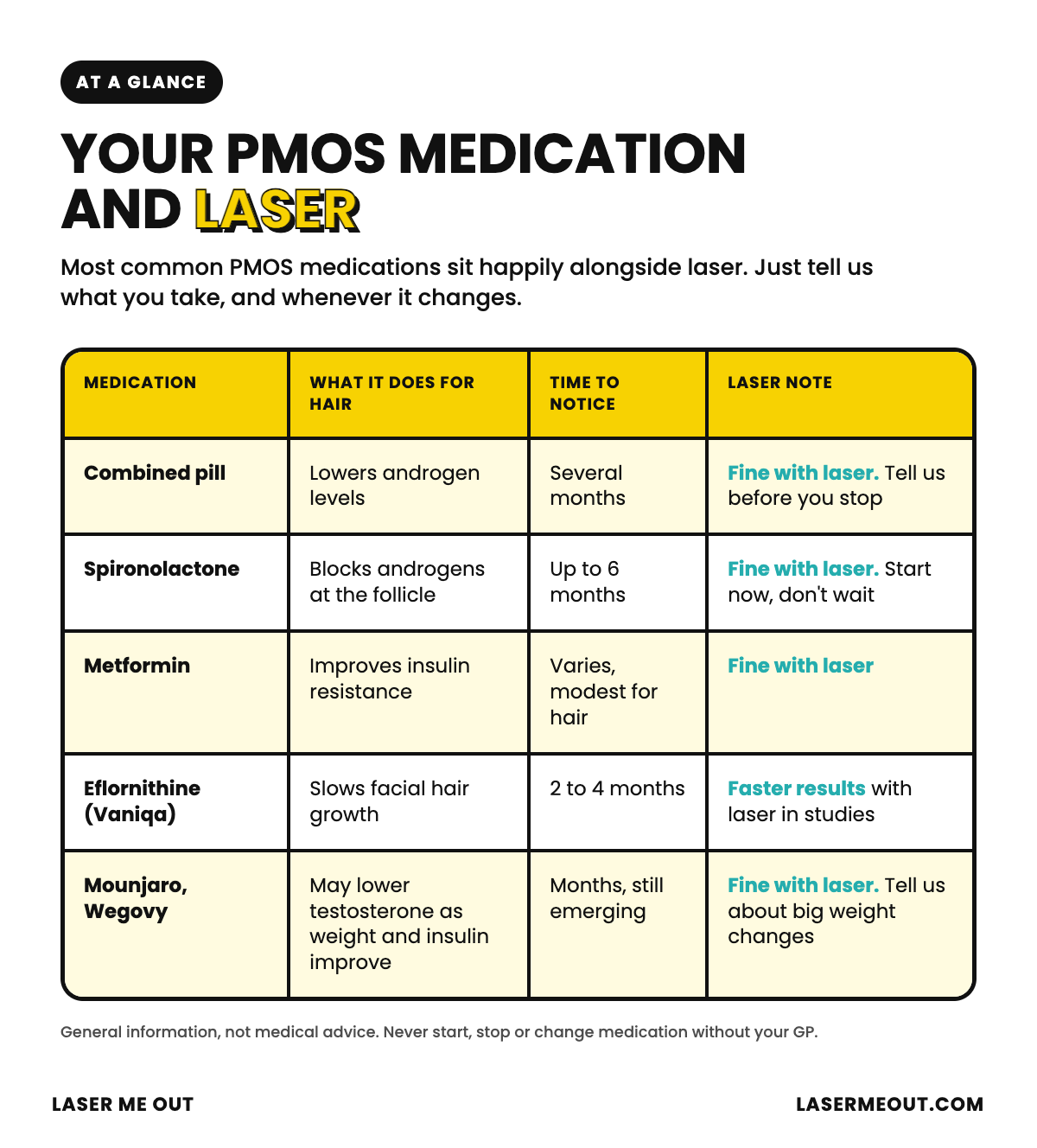
The pill is usually the first thing offered for high androgens. The international PCOS guideline recommends it first-line for managing androgen symptoms in adults, and it sits happily alongside laser.
The moment that matters is stopping. Coming off the pill, whether for a baby or just a break, can bring regrowth, even in areas you'd already cleared. Tell us before you stop and we'll time a maintenance session around it. Our PCOS sessions guide covers this in more detail.
Coming off the pill to try for a baby? Our guide to PCOS, pregnancy and laser hair removal explains when to pause sessions and when to come back.
Spironolactone
Spironolactone blocks androgens and is prescribed off-licence for unwanted hair in women. It's effective, but slow. The NHS says it can take up to 6 months before you notice any improvement in hair growth.
So please don't put laser on hold for half a year waiting for it to kick in. Start your course now. Spironolactone works on new growth over time, while laser gets on with the hair that's already there. If your dose changes, let us know. Your hair may come back finer or slower, and we'll adjust your settings to match.
Planning a pregnancy? Speak to your GP first. The British Association of Dermatologists advises stopping spironolactone if you become pregnant, so your hair plan may change too.
Metformin
Metformin helps your body handle insulin, which is the engine behind PMOS. It's brilliant for metabolic health, but its effect on hair is modest. The NHS Specialist Pharmacy Service says its effectiveness for hirsutism is less clear, though adding it to the pill can help more than the pill alone.
In plain English: metformin won't clear your chin by itself. Laser is still doing the heavy lifting for hair, and the two work together perfectly well.
Eflornithine cream (Vaniqa)
Eflornithine is a prescription cream that slows facial hair growth. The UK product information says to stop if you see no benefit within 4 months, and that you'll still need another hair removal method alongside it.
Here's the interesting bit. In a randomised trial on upper lip hair, adding eflornithine to laser gave faster and more complete results than laser alone. It isn't available everywhere, and some NHS areas no longer prescribe it, so ask your GP or pharmacist. If you use it, tell your therapist and follow their aftercare on when to start applying it again after a session.
Chin and upper lip hair is often the most stubborn with PMOS. Our PCOS facial hair guide explains why, and what a realistic timeline looks like.
Weight-loss injections (Mounjaro, Wegovy)
GLP-1 injections are increasingly used for PMOS because they target weight and insulin resistance. Research shows they can lower total testosterone in people with PCOS, which may ease hair growth over time. Studies measuring hair directly are still small, so treat any hair benefit as a bonus rather than a plan.
They don't stop you having laser. Do tell us if you've lost a lot of weight, though. Skin and hair can change as hormones settle, and we'll reassess your areas and settings.
What to ask your GP about your hair
Hair growth is often treated as a cosmetic side note, but the 2023 International PCOS Guideline treats it as a real part of care. Take these questions to your next appointment:
- Could my treatment help with hair growth, as well as my periods or weight?
- How long before I'd expect to notice a difference in my hair?
- Is it okay to have laser hair removal alongside this medication?
- Would I need to stop this if I'm planning a pregnancy?
- Does this medication make my skin more sensitive to light?
Write the answers down and bring them to your laser consultation. It makes planning your course much easier.
Medicines to flag before any session
Some medicines make your skin more sensitive to light. That doesn't always mean no laser, but it does mean we need to know before we start. Tell your therapist if you're taking, or have recently taken:
- Isotretinoin (Roaccutane), often prescribed for hormonal acne, which is common with PMOS
- Certain antibiotics, such as doxycycline
- Retinoid creams on the area being treated
- Any new prescription or herbal supplement since your last visit
Not sure whether something counts? Bring the box, or a photo of the label. Your therapist will check it and patch test where needed. When in doubt, we'll always pause a session rather than risk your skin.
How we plan your course around your medication
- At your consultation, we go through everything you take and when you started it. We patch test and set your plan from there.
- During your course, we check in at every session. Started something new? Changed a dose? We note it and adjust.
- If you start a new medication mid-course, keep coming. Most PMOS medications don't interrupt laser. We'll just watch how your hair responds.
- If you plan to stop a medication, especially the pill, tell us first. We'll plan a maintenance session for when regrowth is most likely.
- After your course, maintenance sessions catch any new hormonal growth, so your results stay where you want them.
Between sessions: what to do with regrowth
Whatever medication you're on, the rule between sessions is the same: shave, don't pluck.
- Shave or trim any regrowth. It leaves the root in place, which is what the laser needs to target.
- Skip plucking, waxing and threading. They pull the hair out at the root, so there's nothing left for the laser to treat.
- Be gentle with sensitive skin. Some PMOS treatments, like acne creams, can leave skin more reactive. Our shaving routine for sensitive skin and PCOS shows you how to avoid irritation.
- Wear SPF daily on treated areas, especially if you're on anything that makes skin sensitive to light.
Signs your hormones have shifted
Medication changes, weight changes and life changes can all nudge your hormones. Your hair is often the first to show it. Let us know if you notice:
- Dark, coarse hairs coming back in an area you'd already cleared
- Hair growing back faster between sessions than it used to
- Hair appearing somewhere new, such as your neck, chest or tummy
- Regrowth a few months after stopping the pill
None of these mean laser has failed. They mean your hormones are on the move, and your plan needs a tweak. It's also worth mentioning to your GP, as it can be a sign your medication needs reviewing.
Our PMOS offer: 12 sessions of Top to Tail for £1,999.99
Hormonal hair rarely clears in 6 sessions. It usually needs a longer course, and it tends to turn up in more than one place: chin, jawline, neck, chest, tummy. So we've built our Black Friday offer around exactly that.
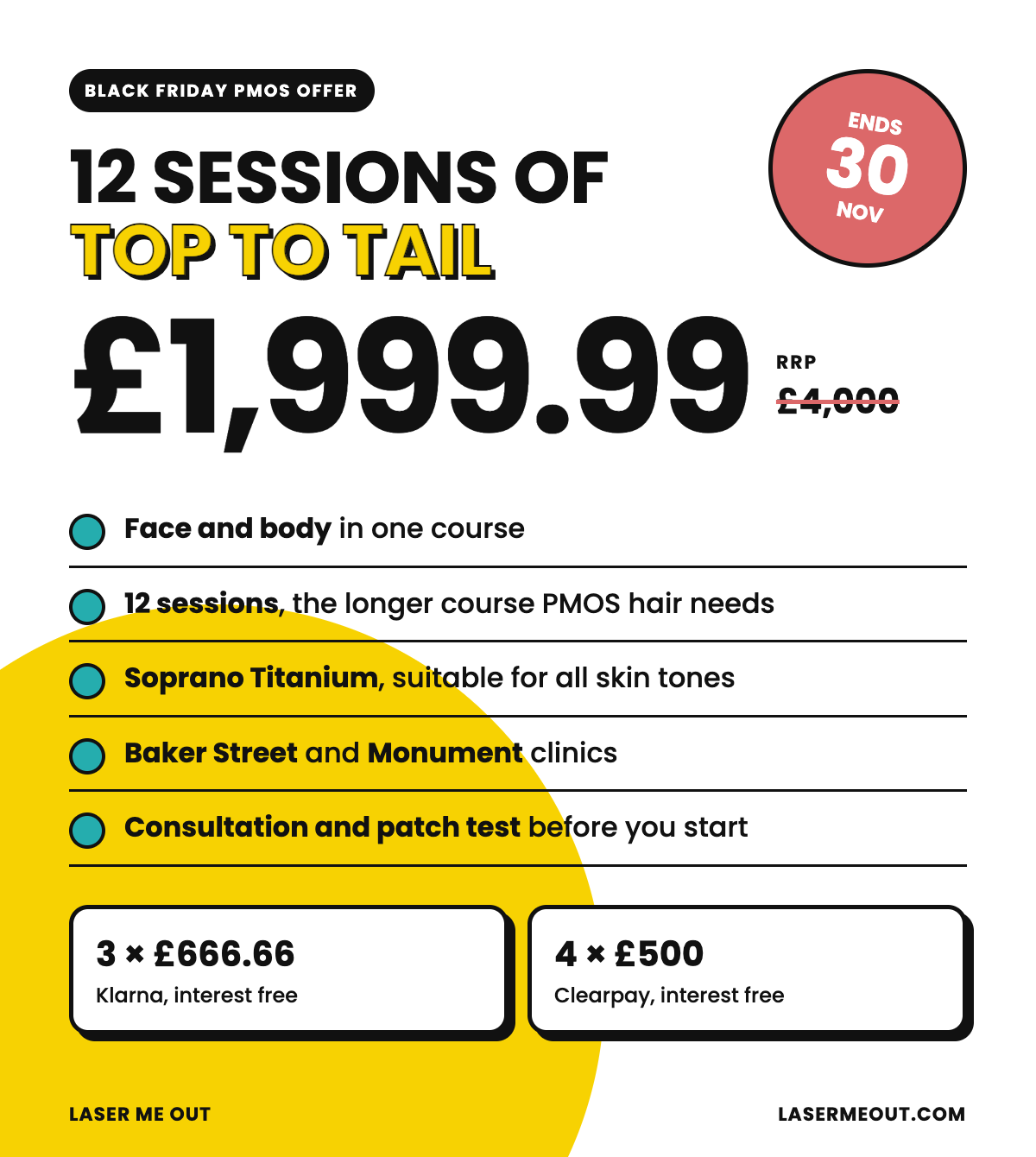
That's Top to Tail, face included, for 12 sessions at £1,999.99 (RRP £4,000). Spread it with Klarna in 3 interest-free payments of £666.66, or Clearpay in 4 of £500. Available at Baker Street and Monument until 30 November 2026.
Why 12 sessions? Because your medication and your laser are working on different timelines. Spironolactone can take 6 months to show its full effect. A 12-session course gives your laser time to clear what's there while your medication slows what's coming, so you're less likely to need extra sessions halfway through.
Every course starts with a consultation and patch test, where we go through your medication and build your plan.
Claim the 12-session Top to Tail offer
FAQs
Should I wait until my medication starts working before booking laser?
No. Medications like spironolactone can take up to 6 months to show results. Starting laser now means you're not waiting half a year to feel smoother.
Will laser still work if I'm on hormone treatment?
Yes. Medication and laser complement each other. Many people find their results last longer between maintenance sessions once their hormones are better managed.
Do I need to stop my medication before a session?
No, and please don't stop anything without speaking to your doctor. We just need to know what you take, so we can check it's safe for your skin.
I'm on Mounjaro and losing weight. Will that affect my laser?
It won't stop your treatment. Tell us about big changes, as your hair growth may change too and we'll review your plan.
Does PMOS hair need more sessions than regular hair?
Usually, yes. Hormonal hair tends to need a longer course plus maintenance. Our PCOS sessions guide walks you through what to expect.
Is laser safe for my skin tone?
Yes. Our Soprano Titanium system uses three wavelengths, including 1064nm for melanin-rich and tanned skin, so it's suitable for all skin tones. Our guide to laser hair removal for darker skin explains how it works.
I'm on Roaccutane for hormonal acne. Can I still book laser?
Tell us before you book. Roaccutane makes skin more sensitive, so your therapist will advise how long to wait after finishing before your first session.
Can I use Vaniqa between laser sessions?
Yes, many people do, and studies suggest the combination works faster. Just tell your therapist so they can advise when to pause and restart the cream around each session.
Is the 12-session Top to Tail offer right for me if I have PMOS?
If your hormonal hair shows up in several areas, it's usually the best value, as it covers your face and body in one longer course. If you only have one stubborn area, such as your chin, a smaller package may suit you better. See our laser hair removal prices by body area, and we'll talk it through at your consultation.
Ready for a plan that works with your meds?
At Laser Me Out, we only do laser hair removal, and hormonal hair is something we see every single day. If you're new to laser for PCOS, our complete guide to laser hair removal for PCOS is a great place to start. We'll build your plan around your hormones, not against them.
Book your consultation and patch test at Baker Street, Monument or Birmingham. Bring your medication list, ask about our 12-session Top to Tail offer before 30 November, and we'll take it from there.
This article is for general information and isn't medical advice. Always speak to your GP or specialist about your medication.
share
interesting article on the same topic
Laser Hair Removal
November 10, 2026
PCOS (PMOS) Medication and Laser Hair Removal: What Actually Works Together
On the pill, spironolactone, metformin or Mounjaro for PMOS? Here's how your medication fits with laser hair removal, what the research says, and what to tell your therapist.
read more
Laser Hair Removal
November 1, 2026

How much does laser hair removal cost in London and Birmingham? 2026 prices by body area
Every laser hair removal price by body area at Marylebone, Monument and Birmingham, what a course really costs, and how we compare with other clinics.
read more
Laser Hair Removal
October 23, 2026

Halloween at Laser Me Out: 9 scary stories we hear every week
Werewolf stubble, radioactive lasers and the one-session spell: the spookiest myths clients tell us, and the real answers.
read more
Laser Hair Removal
October 16, 2026

Meet the people behind your laser hair removal
Meet the Laser Me Out therapists in London and Birmingham, read what clients say about them, and find out what to expect at your appointment.
read more
Laser Hair Removal
October 9, 2026
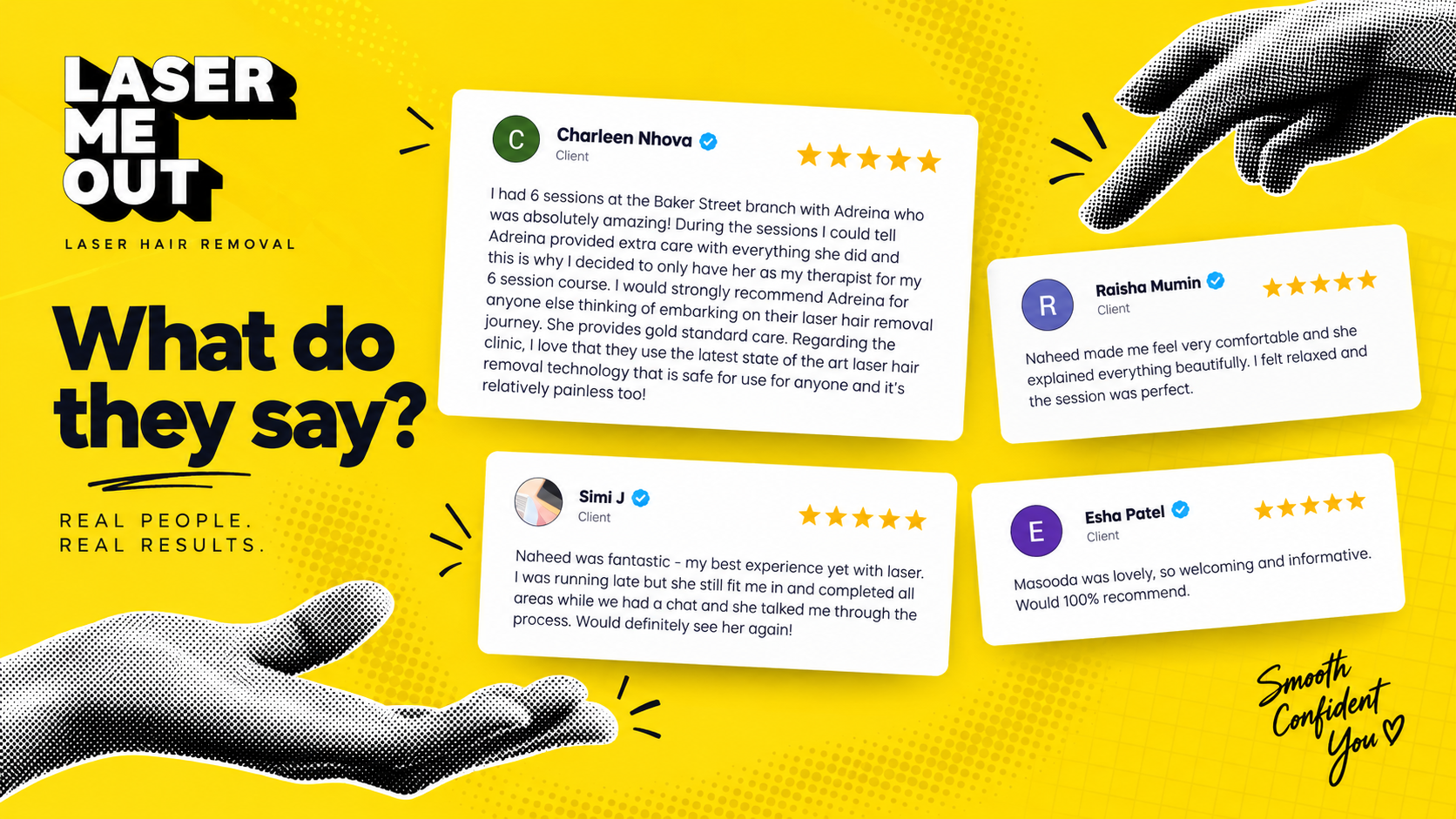
1,000+ Google Reviews: What Our Clients Really Think About Laser Me Out
Thank you for 1,000+ Google reviews. Read what clients say about our therapists and laser hair removal in London and Birmingham.
read more
Laser Hair Removal
September 18, 2026
Your Guide to Less Shaving
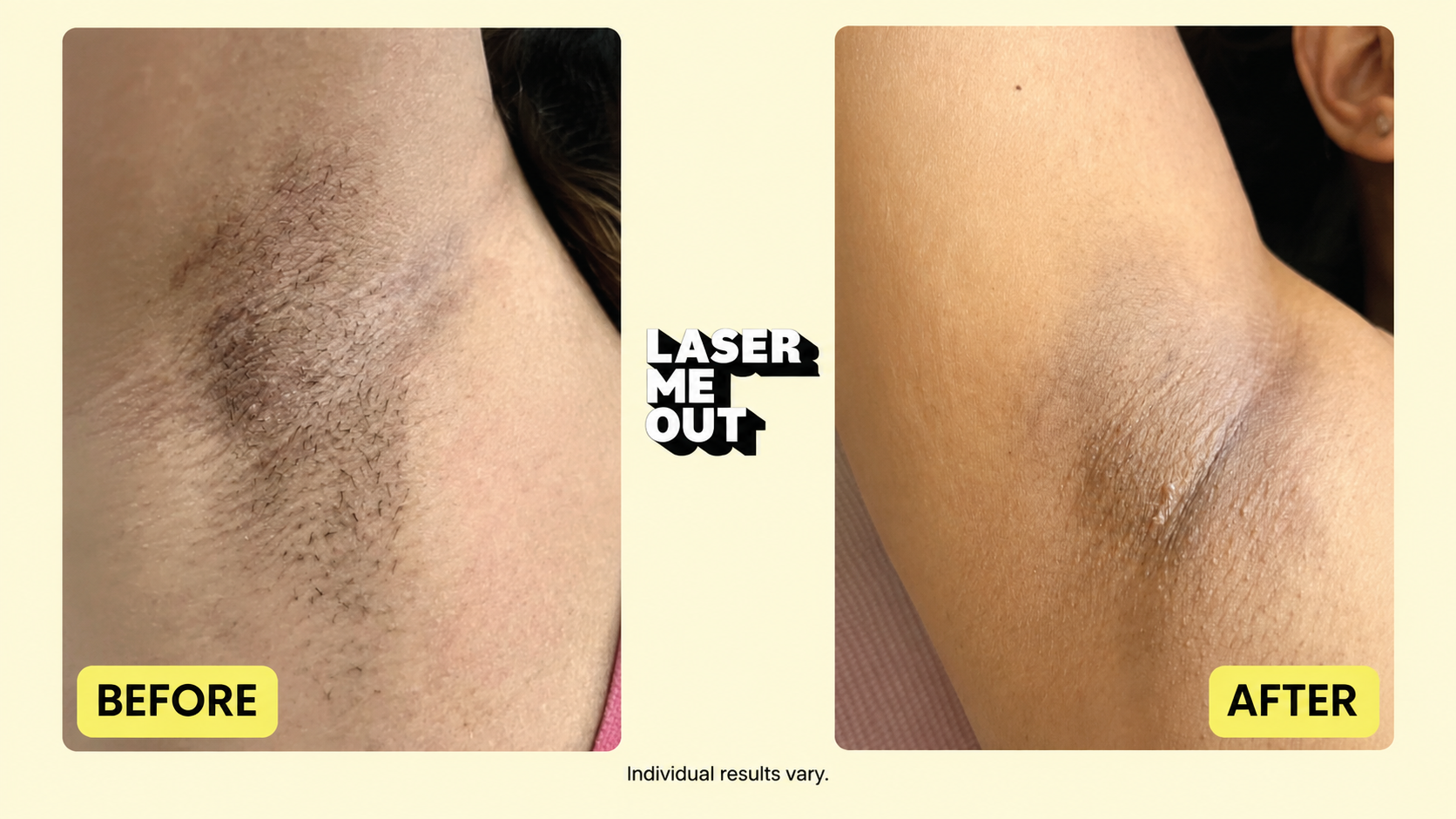
Learn about underarm laser hair removal and our £450 offer: six sessions on any large area plus six free underarm sessions, with consultation and patch test.
read more
Laser Hair Removal
September 11, 2026
Full Body vs Pick & Mix Laser Hair Removal
Full Body, Pick N' Mix or single areas? How to choose the laser hair removal course that fits the areas you want treated, and what to check before you book.
read more
Laser Hair Removal
September 4, 2026

Laser Hair Removal Before Your Wedding
Planning laser before your wedding? When to start, when your final session should be, which areas to prioritise, and why you don't have to wait until winter.
read more
Laser Hair Removal
August 28, 2026
Why September Is the Right Time to Start Laser Hair Removal
Start laser hair removal in September and finish your course before summer. Growth cycles, session spacing, prep and aftercare explained.
read more
Laser Hair Removal
August 21, 2026

Looking for Laser Hair Removal Near Monument? 7 Things to Check
Comparing laser clinics near Monument, Bank or Cannon Street? Seven things to check first, from the laser machine to the patch test.
read more
Laser Hair Removal
August 14, 2026
Can You Get Laser Hair Removal on Your Lunch Break? A Guide for City of London Workers
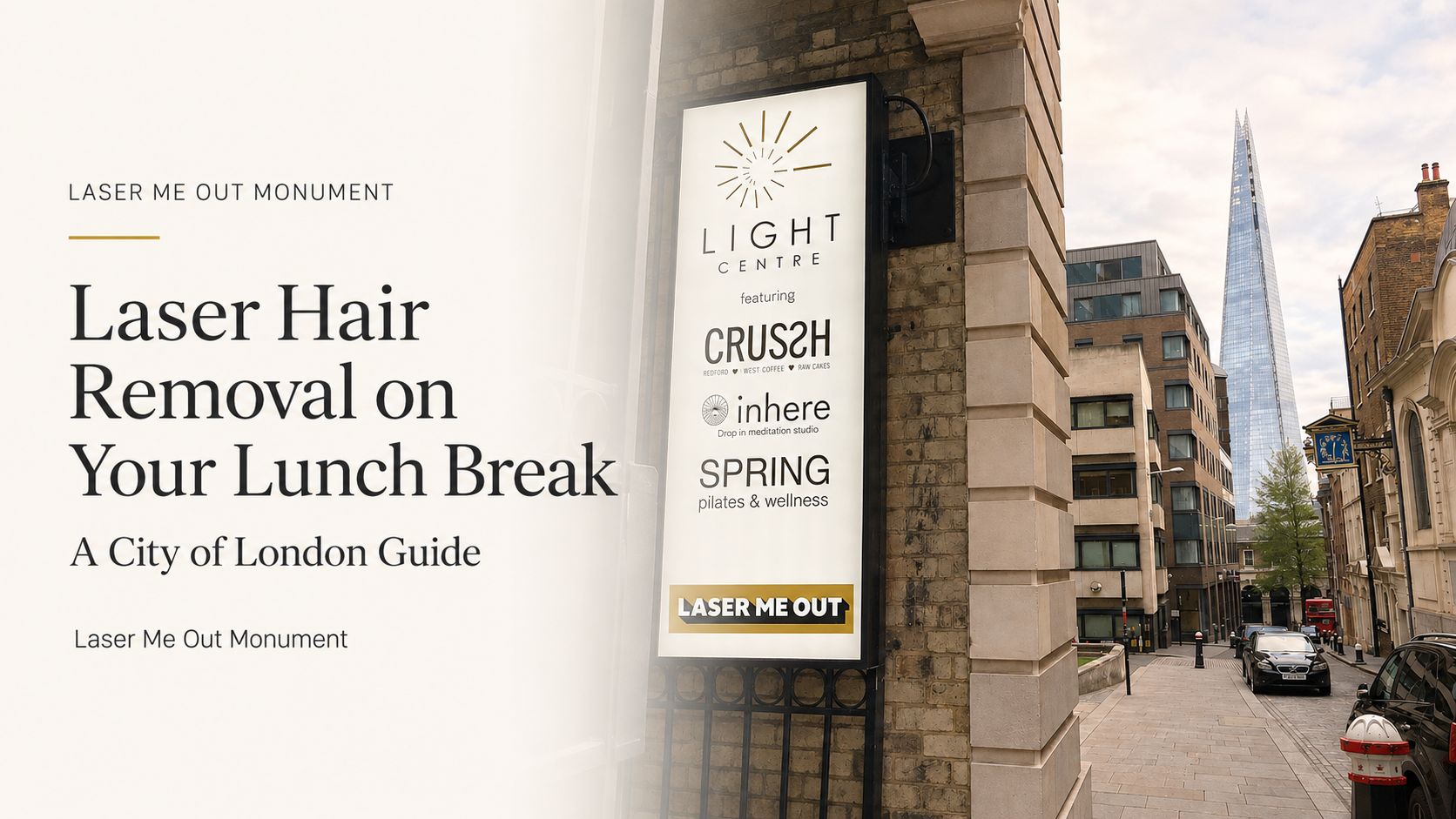
Work near Bank or Monument? Find out how laser hair removal fits around your working day, how long appointments take and why we opened Laser Me Out Monument
read more
Laser Hair Removal
August 7, 2026

Laser Hair Removal in Monument and the City of London
Laser Me Out is now open at 36 St Mary at Hill, EC3R 8DU, minutes from Monument. Soprano Titanium for all skin tones.
read more
Laser Hair Removal
August 1, 2026
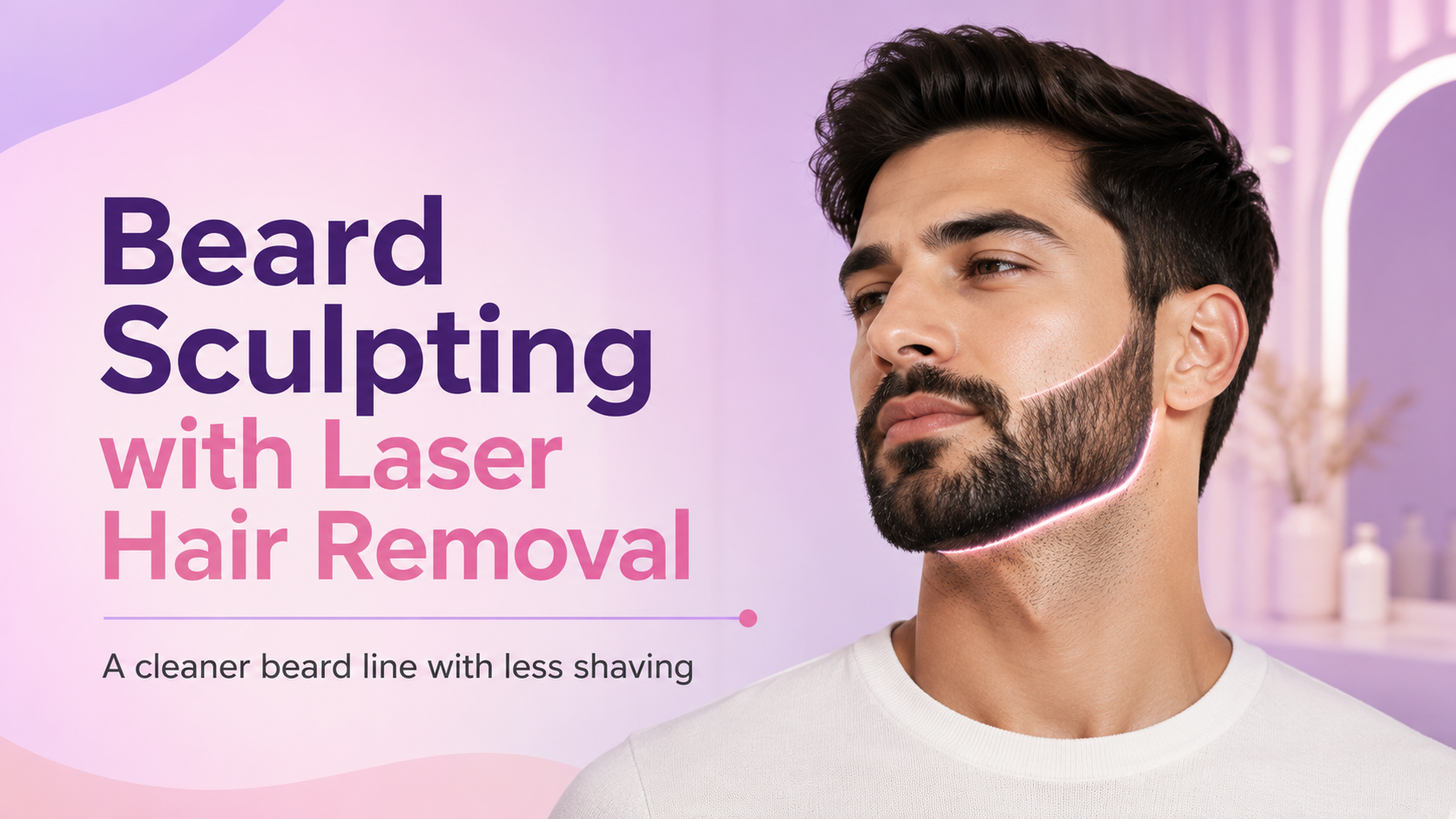
Beard Sculpting with Laser Hair Removal
Laser beard sculpting reduces hair on the neck, cheeks and jaw so your beard line stays sharp without daily shaving.
read more
Laser Hair Removal
July 24, 2026

Hollywood vs Brazilian Laser Hair Removal: What's the Difference?
Hollywood removes all the hair. Brazilian leaves a strip or shape at the front. Here's exactly what each one covers at Laser Me Out
read more
Laser Hair Removal
July 17, 2026
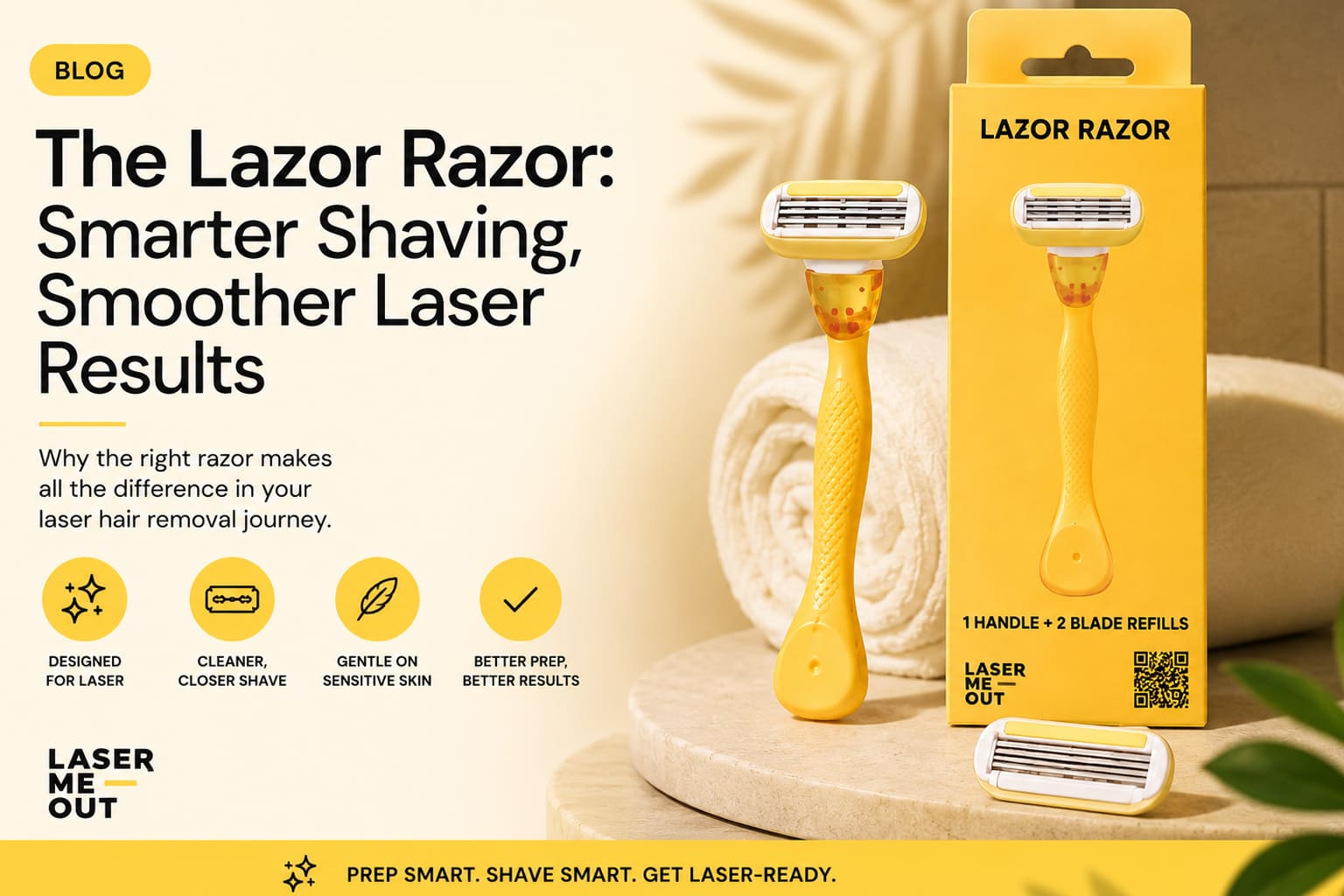
Why Is a Laser Clinic Selling a Razor?
Shaving is still part of every laser course. Here is why we made the Laser Razor and how it helps you prep before each session.
read more
Laser Hair Removal
July 10, 2026

Why the World's Best Athletes Go Hair-Free And Where They Go to Do It
When World No. 1 Aryna Sabalenka visited Laser Me Out during Wimbledon, she proved a point: for elite athletes, hair-free is about performance.
read more
Laser Hair Removal
June 26, 2026
2026 Pubic Hair Trends: Bush, Brazilian & Bare | Bikini Laser London & Birmingham
The biggest pubic hair trend of 2026 isn't one look. It's choice. Bush, strip or bare, here's what's changing
read more
Laser Hair Removal
June 19, 2026
Best Areas to Laser in Summer | Laser Hair Removal Guide
Can you have laser hair removal in summer? Yes the best areas to treat now, and how to stay sun-safe.
read more
Laser Hair Removal
June 12, 2026
Your First Laser Hair Removal Session: Everything You're Wondering
Googling: does it hurt, is a Hollywood awkward, can you train after, and why your hair "growing back" two weeks later is actually good news.
read more
Laser Hair Removal
June 5, 2026
What Really Happens at Your First Laser Hair Removal Consultation: A London First-Timer's Guide
Nervous about laser hair removal? See exactly what happens at your consultation and patch test at our London clinic step by step, with zero surprises.
read more
Laser Hair Removal
May 29, 2026

PCOS, Pregnancy and Laser Hair Removal: Why Hormonal Hair Growth Needs More Support
PCOS, pregnancy and hormone changes can all affect hair growth. How we support hormonal hair with Soprano Titanium and flexible plans.
read more
Laser Hair Removal
May 15, 2026
Goodbye PCOS, Hello PMOS: What the Name Change Means for You
PCOS has been officially renamed PMOS. Here's what it means, why it matters, and what to do next, whether you're diagnosed or wondering if you should be.
read more
Laser Hair Removal
May 7, 2026

Can Pregnancy Reverse Your Laser Hair Removal? Here's What Really Happens
Did pregnancy undo your laser results? Probably not. What happens to treated follicles, when to restart after baby and how many top-ups you need.
read more
Laser Hair Removal
May 1, 2026
How Many Laser Hair Removal Sessions Do You Need?
Most people need 6–10 laser hair removal sessions. See results by body area, what affects session count, and how LMO's dry brushing prep gets you there faster.
read more
Laser Hair Removal
April 24, 2026

Post-Laser Hair Removal Aftercare: What To Do After Your Session
Laser Me Out covering what is normal after laser hair removal, what to avoid, how to look after your skin, and when to contact the clinic.
read more
Laser Hair Removal
April 17, 2026

The Post-Laser Care Guide: From Day 1 to Your Next Session
Think laser hair removal ends when you leave the clinic? Here's what to actually do after: from shedding to skincare, gym to pool, and every mistake to avoid.
read more
Laser Hair Removal
April 10, 2026

Can You Get Laser Hair Removal on Tanned Skin? (Yes Here's How)
Most London clinics say no to laser on tanned skin. At Laser Me Out, we say yes
read more
Laser Hair Removal
March 29, 2026

PCOS Facial Hair: Why Your Chin and Upper Lip Are So Much Harder to Treat
PCOS facial hair is the hardest area to treat with laser here's the real reason why, how many sessions you'll need, and what actually works.
read more
Laser Hair Removal
March 13, 2026
How Many Laser Sessions Do You Need for PCOS?
PCOS laser hair removal takes more than 6 sessions here's exactly why, what happens at each stage, and when to book maintenance. Honest guide from Laser Me Out.
read more
Laser Hair Removal
March 6, 2026

I Started a Laser Clinic Because of My Own PCOS Hair Here's My Story (and What Actually Works)
Laser Me Out founder Shireen has PCOS. Here's her honest story, why laser changed everything, and what PCOS clients need to know before starting treatment.
read more
Laser Hair Removal
February 27, 2026

PCOS Hirsutism Explained Why the Hair Keeps Coming Back
Struggling with PCOS hair growth? Learn why hirsutism keeps coming back and how laser can help reduce regrowth long term
read more
Laser Hair Removal
February 11, 2026

Laser Hair Removal Side Effects: Myths, Facts & FAQs
Worried about laser side effects? We debunk myths and share real safety tips for all skin types.
read more
Laser Hair Removal
February 6, 2026

Hair Removal Myths, Busted
Hair removal myths, debunked. The truth about shaving, waxing, laser, creams, and regrowth, plus how to prep for laser properly.
read more
Laser Hair Removal
January 30, 2026

Is Laser Hair Removal Worth It? Real Costs vs Waxing & Shaving (With Math)
Tired of waxing and shaving? Discover if laser hair removal is worth the cost with a real 5-year price breakdown, expert insight, and long-term benefits.
read more
Laser Hair Removal
January 23, 2026

Why Laser Hair Removal Doesn’t Work for Some People (And What Actually Helps)
Laser hair removal not working? The real reasons, from the machine and hormones to timing and prep, and what to do next for better results.
read more
Laser Hair Removal
January 16, 2026
How to Prevent Strawberry Legs in Winter
Struggling with strawberry legs in winter? Learn what causes them and how to prevent bumps and ingrowns, with expert advice and long-term solutions.
read more
Laser Hair Removal
January 15, 2026

Soprano Titanium vs Other Lasers for Darker Skin Safety & Results
A clear guide to Soprano Titanium vs other laser machines for Asian and darker skin. Real safety notes, comfort differences, and what to expect at Laser Me Out.
read more
Laser Hair Removal
January 2, 2026

Laser Hair Removal Timeline If You Start in January
Starting laser in January? See when results show, when shedding happens, and what to expect after each session.
read more
Laser Hair Removal
December 26, 2025
Start now, stay consistent, be ready for warmer weather.
Winter is the easiest time to start laser in the UK: less sun, fewer tans, easier consistency. Your six-session timeline and what to avoid.
read more
Laser Hair Removal
December 19, 2025
Red bumps on your bum? Here’s what they usually are and how to clear them
Bum spots are not always acne. Most come from irritated follicles, ingrown hairs, friction, sweat or KP. Here is what actually helps.
read more
Laser Hair Removal
December 12, 2025
The common shaving mistake that can damage your skin
Using a dull razor can cause razor bumps, ingrown hairs, itch, and dark marks. Here’s how to shave the right way, plus aftercare tips and long-term options.
read more
Laser Hair Removal
December 5, 2025

Laser Me Out is now open in Birmingham
Safe laser hair removal on Hagley Road using Soprano Titanium, with honest plans for all skin tones and hormonal hair.
read more
Laser Hair Removal
November 21, 2025
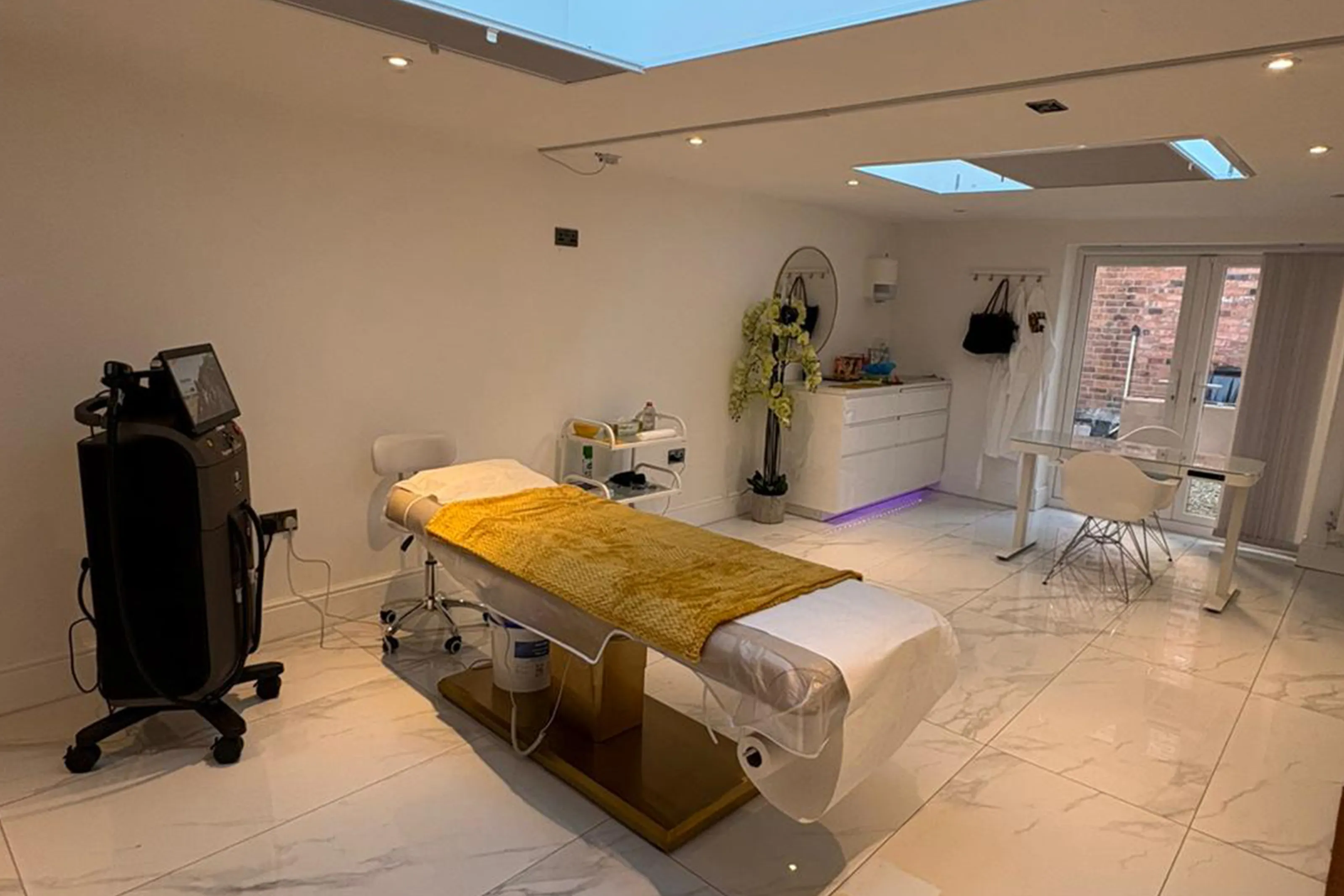
Laser Hair Removal Birmingham on Hagley Road
Laser Me Out has opened on 271 Hagley Road, offering safe laser hair removal for all skin tones. Book a consultation at our new Birmingham clinic.
read more
Laser Hair Removal
November 14, 2025

Laser Hair Removal in Winter: Why It's the Best Time to Start.
Winter is the best time to start laser. Here is how to prep your skin before your patch test and first session for smoother results.
read more
Laser Hair Removal
October 17, 2025

Does Laser Hair Removal Work for PCOS?
Struggling with PCOS hair? How laser hair removal reduces hormonal hair growth safely on all skin tones, with real results and no hype.
read more
Laser Hair Removal
October 3, 2025

Laser Hair Removal Myths Busted Safe, Pain-Free, and Long-Lasting Results
Laser hair removal myths busted safe, pain-free, and effective for all skin tones with Soprano Titanium at Laser Me Out London. Book your consultation today.
read more
Laser Hair Removal
September 26, 2025

What Happens at Your First Laser Hair Removal Consultation
Nervous about your first laser consult? Here’s what happens step by step, from skin check and patch test to plan, safety, and results.
read more
Laser Hair Removal
September 19, 2025

Hollywood laser hair removal: cost, pain, sessions, and what's included
Hollywood laser hair removal in London: cost, pain, sessions, what's included. 6 session (RRP £650). £50 consult redeemable. Soprano Titanium.
read more
Laser Hair Removal
September 12, 2025

Best Laser Hair Removal for Indian Skin (Safe & Effective Options in the UK)
Which laser works best for Indian skin? Why Nd:YAG 1064 is the safest choice, how diode and SHR compare, and what to avoid.
read more
Laser Hair Removal
September 5, 2025
Laser Hair Removal for Men in London - Does It Work?
Does laser hair removal work for men? Sessions, results, beard line bumps, darker skin safety, aftercare. London clinic answers. Book a consultation.
read more
Laser Hair Removal
August 29, 2025
Men’s Laser Hair Removal London | Back, Chest & Beard Line
Explore men’s laser hair removal in London. Treat back, chest, and beard line, fix razor bumps, and get smooth, gym-ready skin.
read more
Laser Hair Removal
August 22, 2025

Lifetime Laser vs Razors & Waxing: What Really Costs More in the UK
Compare lifetime laser hair removal with razors and waxing. See 5- and 10-year UK costs, pros and cons, myths, and who lifetime packages suit.
read more
Laser Hair Removal
August 15, 2025

Shaving Routine for Sensitive Skin, Eczema and PCOS: Laser-Safe Guide
The best shaving routine for sensitive skin, eczema and PCOS. Simple steps to prevent bumps, soothe irritation and prep safely for laser.
read more
Laser Hair Removal
August 8, 2025

Holiday Laser: Is It Safe to Leave the Country Between Sessions?
Going on holiday mid-course? How sun, tanning and missed sessions affect laser results, and when it is safe to treat around your trip.
read more
Laser Hair Removal
August 1, 2025
Complete Guide to Laser Hair Removal for Asian Skin (Fitzpatrick IV–V)
Safe laser hair removal for South Asian and melanin-rich skin: which lasers suit skin types IV to V, what to avoid and what we use.
read more
Laser Hair Removal
July 25, 2025

IPL vs Laser: What's the Real Difference?
At-home IPL or professional laser hair removal? What actually works, what is safe for your skin, and what is worth your time and money.
read more
Laser Hair Removal
July 18, 2025

Best Laser Hair Removal for Dark Skin
The safest laser hair removal for dark and Black skin. Why older lasers carry risks and how Soprano Titanium treats darker skin safely.
read more
Laser Hair Removal
July 11, 2025

Frustrated with Laser Hair Removal Results? Here’s Why It Might Not Be Working
Still seeing hair after laser? You are not alone. The common reasons laser hair removal stops working and what to do about it.
read more
Laser Hair Removal
July 4, 2025

Laser Hair Removal for Trans Women & Non-Binary Folks
Laser hair removal for trans women and non-binary people: how it reduces unwanted hair safely, which areas to treat and what to expect.
read more
Laser Hair Removal
June 13, 2025

Men’s Laser Hair Removal in the UK
Curious about laser hair removal? This guide covers what UK men need to know: results, comfort, and treating thick hair effectively.
read more
Laser Hair Removal
June 5, 2025

Why Isn’t My Laser Hair Removal Working?
8 reasons why your laser hair removal might not be working and the quick fixes you need! Book your consultation with Laser Me Out today.
read more
Laser Hair Removal
May 30, 2025

How to Shave Your Face Before Laser Hair Removal
Learn how to shave your face before laser hair removal step-by-step tips for everyone!
read more
Laser Hair Removal
May 23, 2025

5 Beginner Tips to Prepare for Your Laser Hair Removal Session
Prep for your laser hair removal with these 5 essential tips for a smooth, confident session! ✨
read more
Laser Hair Removal
May 16, 2025

What’s the Best Laser Hair Removal for South Asian Skin?
Looking for the safest laser for South Asian skin? Discover why Soprano Titanium is ideal for melanin-rich tones, with smooth results.
read more
Laser Hair Removal
May 9, 2025
5 Signs You Might Have PCOS
Learn the 5 key signs of PCOS, including irregular periods, acne, and excess hair growth. Discover symptoms, causes, and support options at Laser Me Out.
read more
Laser Hair Removal
May 2, 2025

Is Laser Hair Removal Safe During Pregnancy? Laser Me Out
Wondering if laser hair removal is safe while pregnant? Get expert advice, safe alternatives, and tips for mums-to-be. Read before your next appointment!
read more
Laser Hair Removal
April 25, 2025

Hair Removal for Redheads: What Actually Works
Being a redhead is magic, but dealing with body hair shouldn’t be a myth. Here’s how to go smooth in London (without sacrificing your soul or your skin).
read more
Laser Hair Removal
April 14, 2025

Why Laser Hair Removal Isn’t Working: Expert Insight from Cosmo & Laser Me Out
Featured in Cosmopolitan UK: why laser hair removal results vary, what really works, and how expert-led treatment makes the difference.
read more
Laser Hair Removal
April 4, 2025

Hollywood Laser Hair Removal: The Ultimate Guide to Smooth Confidence
Explore Hollywood laser hair removal with Laser Me Out! Permanent, smooth results for just £199. Safe for all skin tones. Book your consultation now.
read more
Laser Hair Removal
March 21, 2025

Bikini Hair Removal Guide | Find the Best Method for You
Shaving, waxing, sugaring or laser? The pros and cons of each bikini hair removal method and how to choose the best one for your skin.
read more
News
March 14, 2025

Spring Glow: Say Hello to Smooth, Radiant Skin!
Spring is here. Get ready for smooth, hair-free skin before summer and meet the newest faces on the Laser Me Out team.
read more
Laser Hair Removal
March 8, 2025
Top 3 Popular Laser Hair Removal Areas for Women
Discover the most popular laser hair removal zones for women, from bikini lines to legs, and learn why more women are choosing laser over traditional methods.
read more
Laser Hair Removal
February 27, 2025
Where Is the Most Painful Area for Laser Hair Removal?
Does laser hair removal hurt? We rank the most sensitive areas, compare the pain with other methods, and share tips for comfortable sessions.
read more
Laser Hair Removal
February 21, 2025
Is Laser Hair Removal Really Permanent? Here’s What You Need to Know
Is laser hair removal permanent? How it works, what affects long-term results, and why a few maintenance sessions keep skin smooth.
read more
News
February 14, 2025

Double the Love: Everything You Need to Know About Our Valentine’s Laser Offers 💖
Everything you need to know about our Valentine’s laser hair removal offer, from how it works to which areas and skin tones it covers.
read more
Laser Hair Removal
November 25, 2024

How does Electrolysis help with Menopause?
Menopause can bring new facial and body hair. How electrolysis can help remove it and what to expect from treatment at Laser Me Out.
read more
Laser Hair Removal
November 15, 2024

Laser vs Electrolysis: What’s best for you?
Laser or electrolysis? How the two hair removal treatments differ in speed, comfort and results, so you can choose the right one for you.
read more
Laser Hair Removal
November 5, 2024
Sustainability: Everything We Are Doing to Improve Our Environmental Footprint
How Laser Me Out is reducing its environmental footprint, from the treatment room to the front desk, and the changes we are making next.
read more
Laser Hair Removal
October 25, 2024

Winter is best season to start your Laser Hair Removal Journey - Here’s Why
Short days and little sun make winter the perfect time to start laser hair removal. Here is why, and how to plan your sessions.
read more
Laser Hair Removal
October 20, 2024
Why are more men choosing Laser Hair Removal
Thicker, coarser hair and hard-to-reach areas make shaving tough for men. Why more men now choose laser hair removal, and the benefits.
read more
Laser Hair Removal
October 15, 2024

Laser Hair Removal - A Detailed Guide for Transgender People
A guide to laser hair removal for transgender people, with or without HRT: how it works, which areas to treat and what to expect.
read more
Laser Hair Removal
October 15, 2024
I Am Trans: Can I do laser hair removal
Yes, trans people can have laser hair removal, including during hormone therapy. Common treatment areas, how it works and what to expect.
read more
Laser Hair Removal
October 10, 2024
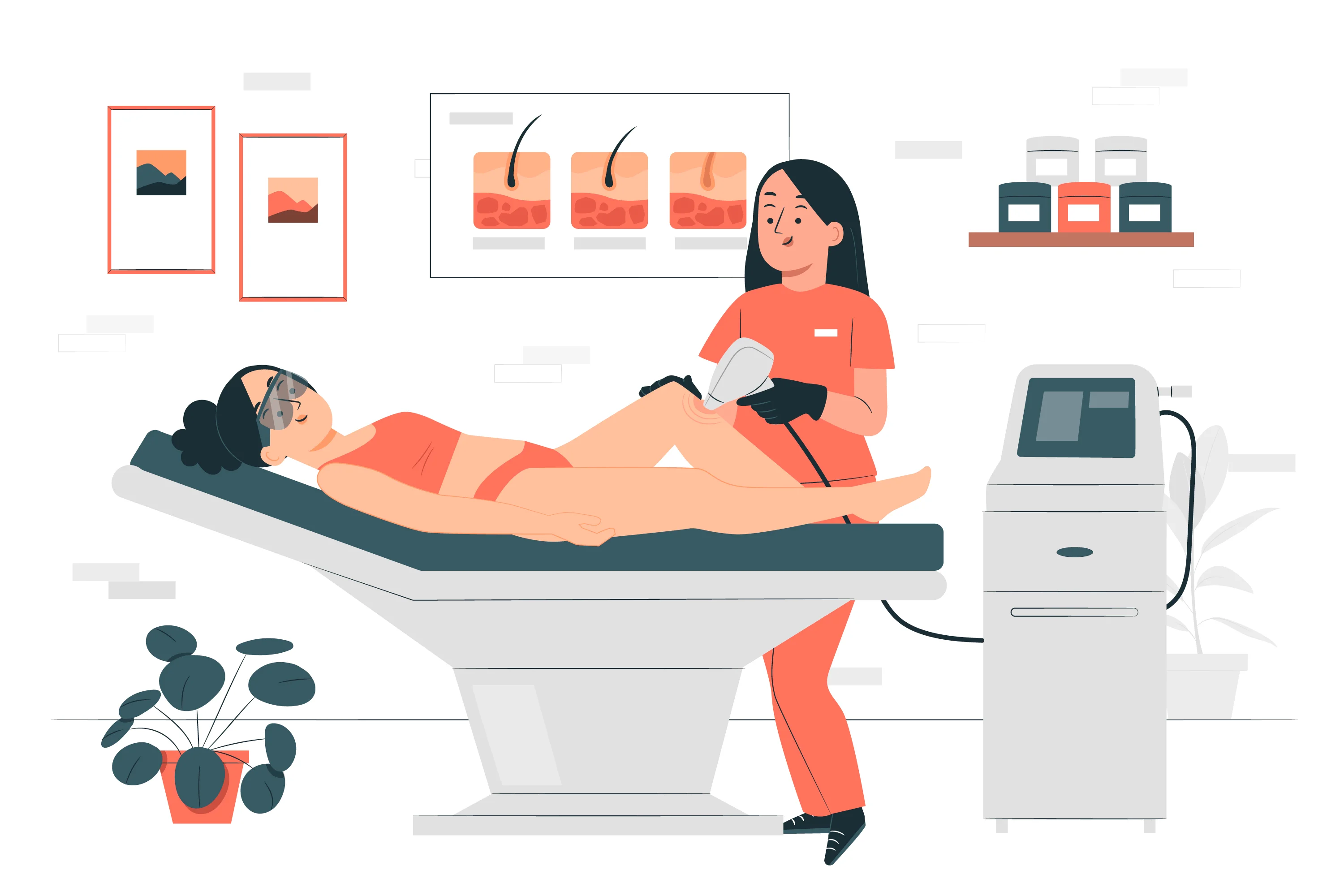
Let’s talk Science: How does Laser Hair Removal actually work?
How does laser hair removal actually work? The science behind it, how different machines compare, and answers to the common questions.
read more
Laser Hair Removal
August 19, 2024

My Personal Journey to Tan-Friendly Laser - Embrace Summer with Confidence!
Love a summer tan? A personal story of finding tan-friendly laser hair removal and staying smooth with confidence all summer.
read more
News
August 19, 2024

Major Clinics Shutting Down: How Can You Trust Paying Upfront for a Course?
A major high-street clinic chain collapsed and many clients lost money. How to protect yourself before paying upfront for a laser course.
read more
Laser Hair Removal
July 19, 2024
Say goodbye to ingrown hairs and pigmentation
Picking ingrown hairs left dark marks and textured skin. A personal story of how laser hair removal helped with ingrowns and pigmentation.
read more
Laser Hair Removal
July 18, 2024

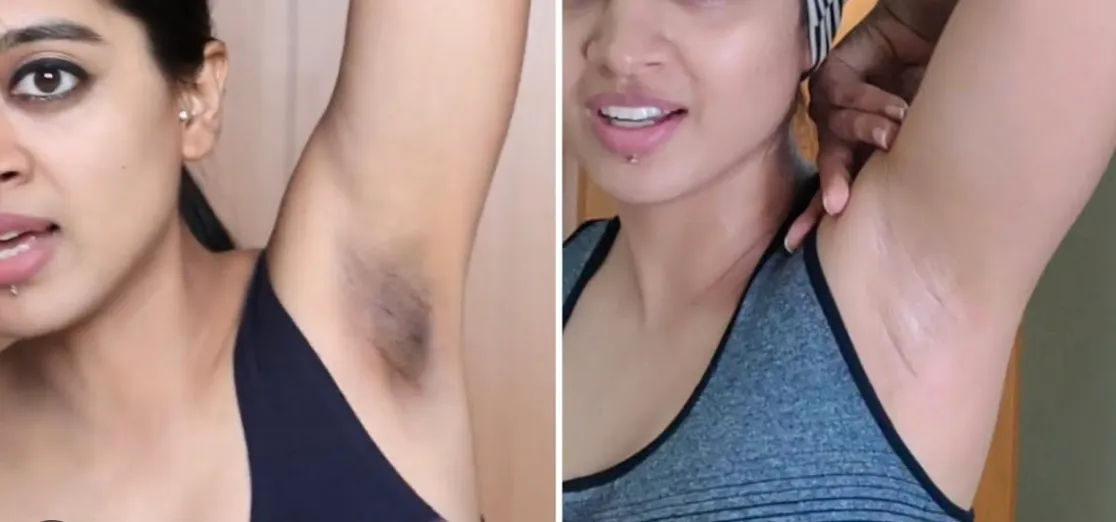
How to Treat Dark Underarms
Dark underarms? Why lemon, scrubs, shaving and waxing often do not help, and how laser hair removal can help even out the area.
read more
Laser Hair Removal
April 8, 2024

So many clinics, countless laser options - how to choose the right one for me?
With new clinics opening every week and so many lasers on offer, here is how to choose the right laser and the right clinic for you.
read more
Skin
April 8, 2024

Say goodbye to pain with our pain-free laser hair removal!
Dread hair removal? How our pain-free laser hair removal works and what a session really feels like, from start to finish.
read more

contact us
let´s talk hair. dm us today.
We’re obsessed with fuzz-free living and love to share our knowledge and expertise. Don’t be shy! Ask us anything.
London´s prime location
Laser all day baby - hours that work for you! Situated at 146 MARYLEBONE Rd., London NW1 5PH
MON
9.00 - 21.00
TUE
9.00 - 21.00
WED
9.00 - 21.00
THU
9.00 - 21.00
FRI
9.00 - 21.00
SAT
9.00 - 21.00
SUN
9.00 - 21.00

Birmingham´s prime location
Laser all day baby - hours that work for you! Situated at 271 Hagley Rd, Birmingham B16 9NB
MON
9.00 - 21.00
TUE
9.00 - 21.00
SAT
9.00 - 21.00